Court dress
Dragon robes and court dress of the Qing
Who could wear a five-clawed dragon, why robes were yellow and what a dressing-up service can and cannot copy.
Reserve my table ↗Quick answer
In the Qing, the longpao dragon robe belonged to the emperor, his consorts and the crown prince, with five-clawed dragons. A costume service gives you the look and the photographs, not the rank, and the booking page does not say which garments it uses.
Court dress in brief
| Item | What Wikipedia says |
|---|---|
| Longpao | Robes of the emperor, his consorts and the crown prince, with five-clawed dragons |
| Four-clawed dragon | Called a mang, worn by honoured office-holders rather than the emperor |
| 1636 code | Emperor and first-rank princes could wear yellow robes with five-clawed dragons |
| Early eighteenth century | A robe with nine dragons became the Qing pattern |
The dragon and the claws
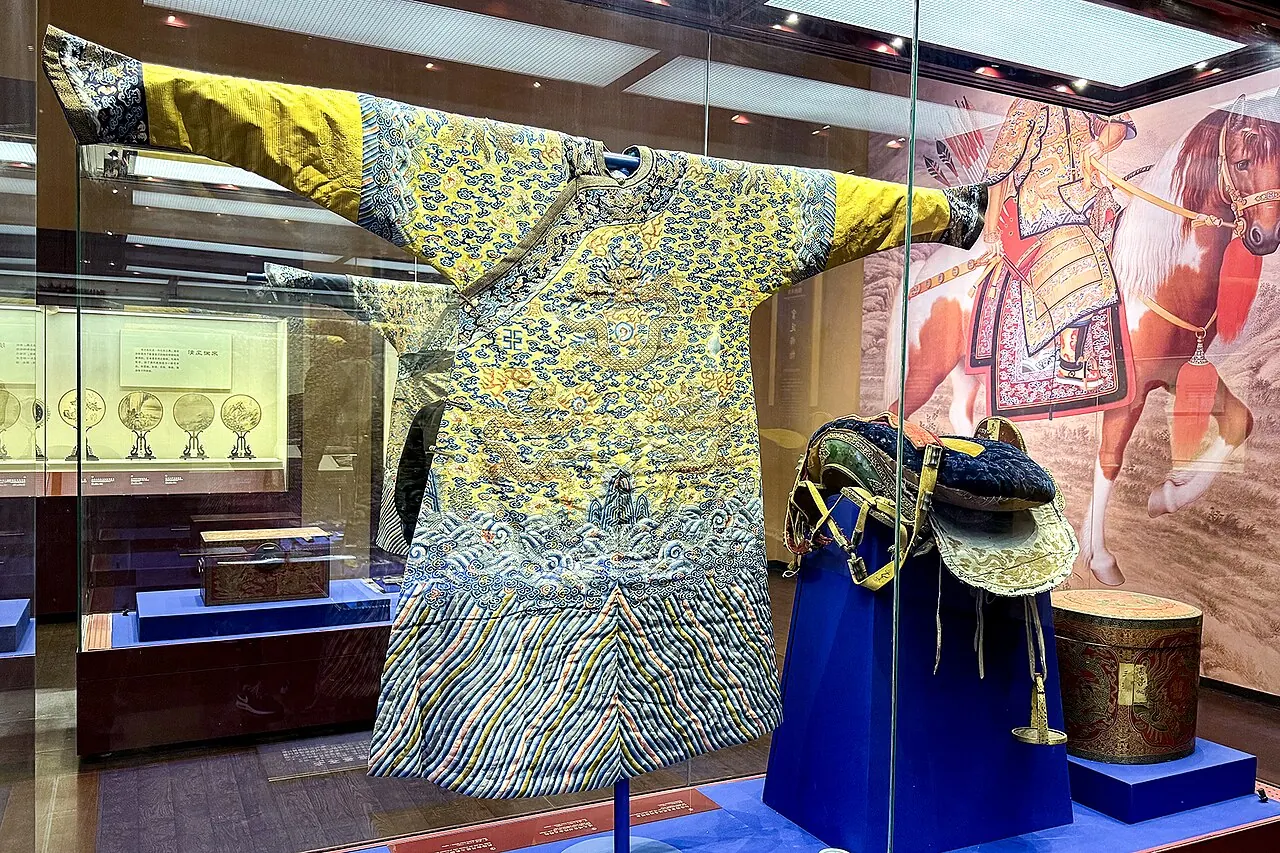
Dragon robes, Wikipedia says, are clothing with a Chinese dragon as the main decoration, worn in the past by emperors of China. Since the Ming, the Chinese dragon has five claws; a four-clawed creature is not counted as a dragon but as a mang, and the mang robe was a garment close to the emperor’s but with one claw less.
Who could wear what
In the Qing, the article explains, the term longpao fitted only the clothing of the emperor, his consorts and the crown prince, typically decorated with five-clawed dragons and the twelve symbols depending on rank. Qing sumptuary laws let office-holders, Han Chinese nobles and Manchu nobles wear four-clawed mang, while the emperor, the imperial family and princes up to the second degree were entitled to five-clawed dragons.
Yellow, from 1636
The Manchu dress code of 1636, the article says, allowed the emperor and first-rank princes to wear yellow robes with five-clawed dragons. The early Manchus did not weave their own textiles at first, and had to obtain Ming dragon robes and cloth through tribute or trade.
A new cut for riders
Hong Taiji, the first Qing emperor, did not want to dress only as the Han Chinese did. The Ming robes were therefore modified, narrow at the sleeves and waist with slits in the skirt so they suited falconry, horse riding and archery. From the early eighteenth century, the Qing court set a dragon robe with nine dragons.
Twelve symbols
By 1759, according to the article, all Twelve Ancient Symbols of Imperial Authority had been added to the emperor’s dragon robes, after the first Qing emperor had rejected them. A museum case today shows how dense the embroidery is.
What a dressing-up service gives you
The Beijing banquet offers an optional costume and make-up service at extra cost in basic and advanced levels, and recommends arriving about an hour early for it. The page does not say which garments are offered. Treat the result as a portrait costume in the spirit of court dress, and enjoy it without expecting the rank rules above to apply.
Read next: Royal dining evening in Beijing: worth it, or a tourist trap?
Frequently asked questions
Why five claws?
Since the Ming, Wikipedia says, the Chinese dragon has five claws, and a four-clawed creature counts as a mang.
Did only the emperor wear yellow?
A 1636 code let the emperor and first-rank princes wear yellow robes with five-clawed dragons.
Does the banquet’s costume match a real robe?
The booking page does not say which garments are used.
Sources